


Rotational mold innovations shaping 2025 trends
I see rotational mold products everywhere—in cars, farms, and playgrounds. Market growth remains strong, with materials expected to reach $3.22 billion in 2025. Demand keeps rising as industries want lighter, tougher goods. 
Key Takeaways
- Rotational Molding creates strong, lightweight, anddurable products used in many areas like tanks, automotive parts, playground equipment, and furniture.
- New materials and automation in 2025 make rotational mold products greener, smarter, and more efficient, improving quality and reducing waste.
- These innovations help industries save money, protect the environment, and offer safer, longer-lasting products for everyday use.
Rotational mold products and applications
Large containers and tanks
I see large containers and tanks made with rotational mold technology in many industries. These tanks store water, chemicals, and fuel for agriculture, construction, and municipal needs. The process creates seamless, watertight tanks with even wall thickness. This makes them strong and less likely to leak or crack. I notice that polyethylene is the most common material, chosen for its toughness and chemical resistance. Some tanks use high-density polyethylene (HDPE) or cross-linked polyethylene for extra durability. Sizes range from small 20-gallon tanks to huge ones holding thousands of gallons.
Tanks made with rotational mold methods last longer and resist corrosion better than metal tanks. They also come in many shapes and sizes to fit different jobs.
| Material Type | Volume Capacity (Gallons) | Typical Dimensions (L x W x H in inches) |
|---|---|---|
| Poly Cage Composite | 275 - 330 | 45 x 40 x 46 to 48 x 40 x 53 |
| High Density Polyethylene (HDPE) | 120 - 550 | 45 x 45 x 36.5 to 81 x 48 x 60 |
| Carbon Steel | 110 - 550 | 48 x 40 x 20 to 48 x 42 x 71 |
| Stainless Steel | 110 - 550 | 48 x 40 x 20 to 48 x 42 x 71 |
Automotive parts and components
I find that the automotive industry uses rotational mold products for many parts. These include fuel tanks, ducts, hoses, dashboards, and door panels. The process makes parts that are lightweight and corrosion-resistant. This helps reduce the weight of vehicles, which improves fuel efficiency and lowers emissions.
- Fuel tanks: lightweight, corrosion-resistant, and meet safety standards.
- Ducts and hoses: used in engine intake and exhaust systems.
- Dashboards and door panels: durable and customizable.
- Rotational mold fuel tanks weigh less than metal tanks, helping cars use less fuel.
- Lighter vehicles need less energy, so they pollute less.
- The process allows for complex shapes, making better use of space inside the car.
- Plastic tanks last longer and need less maintenance.
- The method is cost-effective, especially for small and medium production runs.
Playground and recreational equipment
When I visit playgrounds, I see many slides, swings, and climbing structures made with rotational mold plastics. These products must meet strict safety standards like ASTM and CPSC rules. They also need to be ADA compliant so all children can play. Rotational molding gives these products uniform wall thickness and flexibility, making them less likely to crack or break.
Rotational mold playground equipment is safer and more durable than older wood or metal equipment. It resists weather, does not splinter, and is easy to clean.
| Material Type | Durability & Strength | Safety & Maintenance | Suitability for Age Groups |
|---|---|---|---|
| Rotationally Molded Plastic | Durable, flexible, uniform wall thickness; resists cracking under extreme temperatures; weather-resistant | No splinters or rust; low maintenance; resists stains and graffiti | Ideal for younger children due to safety and design flexibility |
| Wood | Strong and robust; long-lasting but needs upkeep | Natural look; regular maintenance; splinters | Best for older children and adults |
| Metal | Very strong; can rust if untreated; can get hot | Low maintenance if treated; safety concerns in heat | Best for older children and adults |
Industrial and agricultural solutions
I see rotational mold products used in agriculture and industry for tanks, bins, hoppers, and containers. These products store chemicals, water, oil, and waste. They also serve as parts for machines and vehicles. The process makes items that are tough, stable, and able to handle harsh conditions.
- Industrial plastic hoppers
- Agricultural equipment
- Commercial dumpsters
- Storage tanks (septic, chemical, oil)
- Packaging containers (IBCs, drums, barrels)
- Tote bins and trash cans
Rotational mold products help farmers and factories save money. They last a long time, resist chemicals and UV rays, and need little maintenance. Custom designs fit special needs and make work more efficient. Smooth surfaces make cleaning easy and reduce contamination risks.
Consumer goods and furniture
In homes, schools, and offices, I notice many consumer goods and furniture made with rotational mold technology. Plastic chairs and tables are very popular because they are strong, lightweight, and easy to move. Storage cabinets and shelves made this way are modular and durable.
- Plastic Chairs and tables
- Storage solutions (cabinets, shelves)
- Sports and recreation items (kneeboards, lifeguard seats)
- Cleaning machine parts
- Mobile trash collectors
Rotational molding lets designers create unique shapes, double walls, and seamless edges. This means furniture can be both stylish and sturdy. The process also allows for textures and colors to be added directly, making each piece special.
I appreciate how rotational mold furniture combines durability, design freedom, and cost savings. It is easy to see why these products are so common in daily life.
2025 innovations in rotational mold technology

Advanced materials and composites
I see big changes coming in the materials used for rotational mold products. Companies now use more recyclable and sustainable polymers. They also add bioplastics, UV-resistant, and fire-retardant materials. These changes help make products safer and better for the environment. I notice that EVOH materials are popular for food and medicine packaging because they block air and moisture. Manufacturers blend different polymers to improve strength and lower costs. I also see natural fibers, like banana fibers, mixed into plastics. This makes products stronger and uses less plastic. It also cuts down on waste and CO2 emissions. Advanced composites give products better resistance to chemicals and damage, which means they last longer and work in more places.
- More recyclable and sustainable polymers
- Use of bioplastics, UV-resistant, and fire-retardant materials
- EVOH for high-barrier packaging
- Natural fibers for strength and lower emissions
- Advanced composites for durability and chemical resistance
Smart and connected rotational mold products
I notice that smart features are now common in rotational mold products. Sensors and IoT technology let me track how products work in real time. For example, I can monitor temperature and cycle times during production. This helps me spot problems early and fix them fast. In factories, IoT connects machines and business systems. This makes it easier to plan work and keep everything running smoothly. Some products even have built-in sensors for healthcare or safety uses. These smart features improve quality, save energy, and reduce waste.
Design flexibility and rapid customization
I see that new technology gives me more freedom to design unique products. Electrically heated molds and robotic arms let me make complex shapes and use different materials. I can now create products with special layers or inserts for extra strength. 3D printing and computer-aided design (CAD) help me test ideas quickly. I can make several versions of a product without making new molds each time. This saves money and speeds up production. For example, I once helped design a custom tank for a farm. We tested many shapes and materials until we found the best one, all in a short time.
Automation and process efficiency
Automation has changed how I work with rotational mold products. Robotic arms handle heavy molds and take out finished parts, which keeps workers safe. Automated systems load materials and control temperature, making sure every product is the same quality. Real-time data from sensors helps me spot problems and fix them before they get worse. AI and machine learning adjust settings to save energy and reduce waste. I have seen production cycles get faster and more reliable. This means I can make more products with less effort and lower costs.
Applications shaped by 2025 rotational mold trends
Eco-friendly and recyclable solutions
I see a big shift toward eco-friendly products in the rotational mold industry. Companies now use more recycled plastics, especially recycled polyethylene. Bioplastics are also becoming popular. I notice that new additives, like BASF's VALERAS, help make plastics stronger and easier to recycle. Technologies such as Irgatec CR improve how we use materials, making the process more efficient and sustainable. Here are some leading eco-friendly materials I see used in 2025:
- Recycled plastics (mainly polyethylene)
- Bioplastics for sustainable options
- Additives that boost recyclability and durability
- Biodegradable plastics for greener products
Rotational molding creates less waste than other methods. The plastics used are often recyclable, and biodegradable options are now available. These changes help protect the environment and support a circular economy. I find that products made this way last longer and need less maintenance than wood or metal. At the end of their life, many can be recycled into new items.
High-performance industrial products
I have seen major improvements in industrial products made with next-generation rotational molding. New materials and process innovations give these products better strength, heat resistance, and durability. For example, glass-filled polyethylene resins reduce shrinkage and boost tensile strength. Advanced materials like cyclic olefin copolymers offer high stiffness and heat resistance. These changes help industries like aerospace, automotive, and packaging.
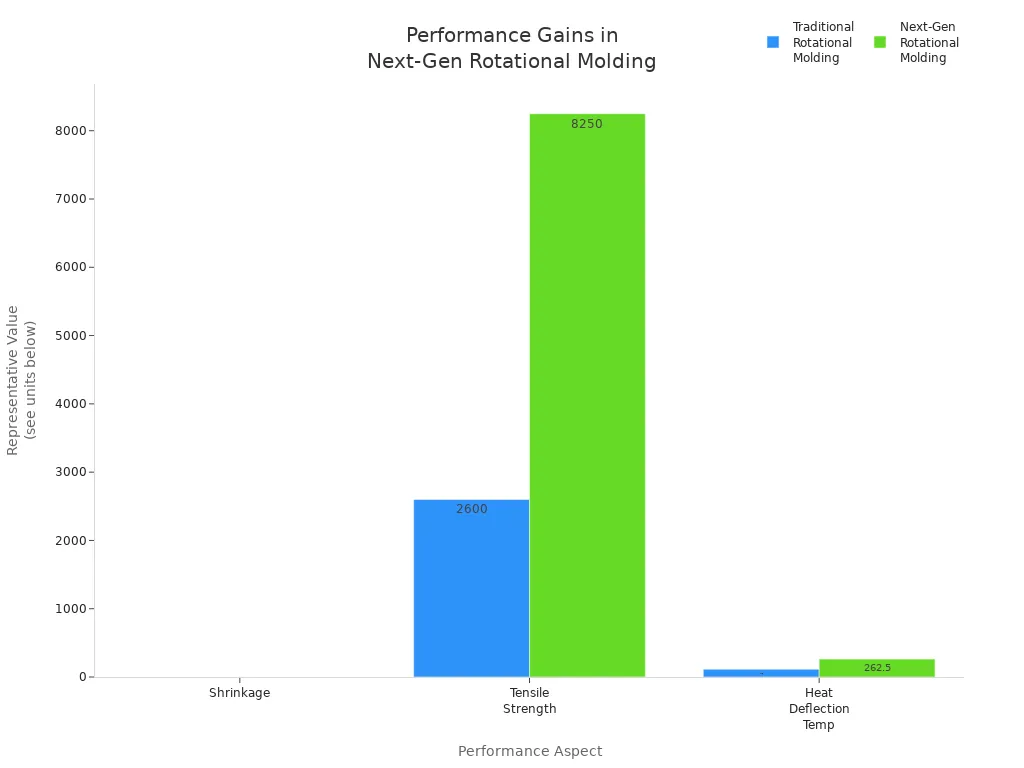
I notice that these products last longer, resist weather and chemicals, and cost less to maintain. Industries like material handling, construction, and packaging now use these high-performance parts for their strength and reliability.
Next-generation consumer and recreational items
I see that next-generation rotational mold products make a big difference in daily life. Toys and playground equipment now have bright colors, soft edges, and seamless designs. This makes them safer and more fun for kids. New resins, like RESILITY™ polyethylene, give products better impact resistance and flexibility. These items last longer outdoors and stay safe even after heavy use.
- Playground equipment now includes ramps and sensory features for all children.
- Toys and sports gear have better grip and slip resistance.
- Many products use recyclable materials, helping the environment.
I have visited parks with new playgrounds that use these innovations. The equipment looks great, feels safe, and lasts longer, giving communities better value.
I see rotational mold products growing more important every year. The market is set to reach $3.22 billion in 2025, driven by new materials and automation. These innovations make products stronger, greener, and more efficient. I expect even greater impact as technology keeps advancing.
FAQ
What makes rotational molding different from other plastic forming methods?
I see that rotational molding uses heat and rotation to form hollow parts. I do not need high pressure or complex molds. This process works well for large, seamless products.
Can I recycle rotationally molded products?
I often recycle these products. Most use polyethylene, which I can melt and reuse. Some new bioplastics also break down naturally, making them even more eco-friendly.
How do new materials improve rotational mold products?
- I use advanced materials to boost strength and durability.
- Some materials resist UV rays and chemicals.
- I find that these changes help products last longer outdoors.